
What Is a Buffer Solution? How It Works, Formula, and How to Calculate pH


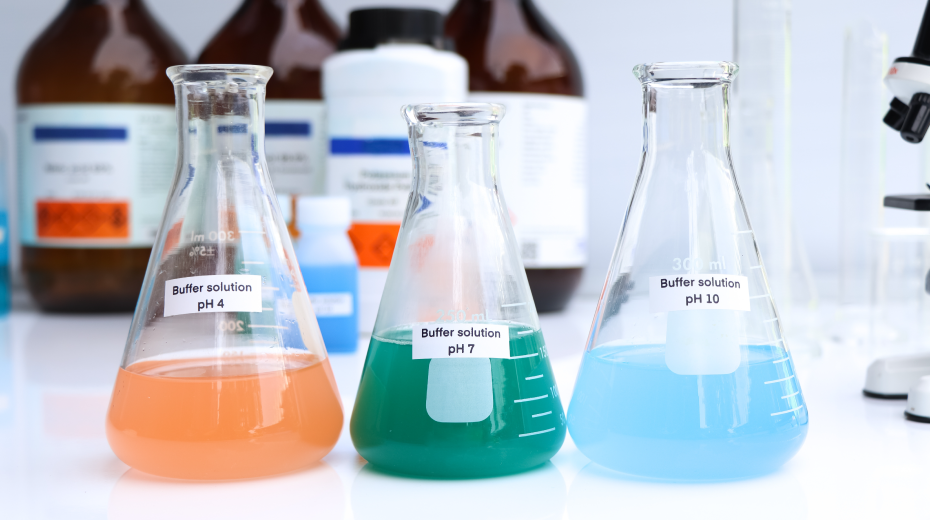
Buffer calculations are one of the topics many A-level and IB students struggle with. That’s because this topic brings together weak acids, conjugate pairs, equilibrium, and logarithmic calculations in a single chapter.
The topic sits under Acid-Base Equilibria in the A-level H2 Chemistry and IB HL Chemistry syllabus. If you’ve been asking questions like what is a buffer solution (especially beyond the textbook explanations) and more, you’re in the right place. We explain it here in a way that should make it easier to understand.
What Is a Buffer Solution?
A buffer solution is a solution that maintains a fairly constant PH when small amounts of acid or base are added to it.
Notice the word “fairly” in the definition. The pH still changes a little, you see: just not by much. Never write “pH remains constant in buffer solutions” in an exam!
Every buffer contains a conjugate acid-base pair. There are two types of buffers:
- Acidic buffer - A weak acid + salt of its conjugate base, e.g., CH₃COOH + CH₃COONa, typically below pH 7.
- Alkaline buffer - A weak base + salt of its conjugate acid, e.g., NH₃ + NH₄Cl, typically above pH 7.
How Do Buffer Solutions Work?
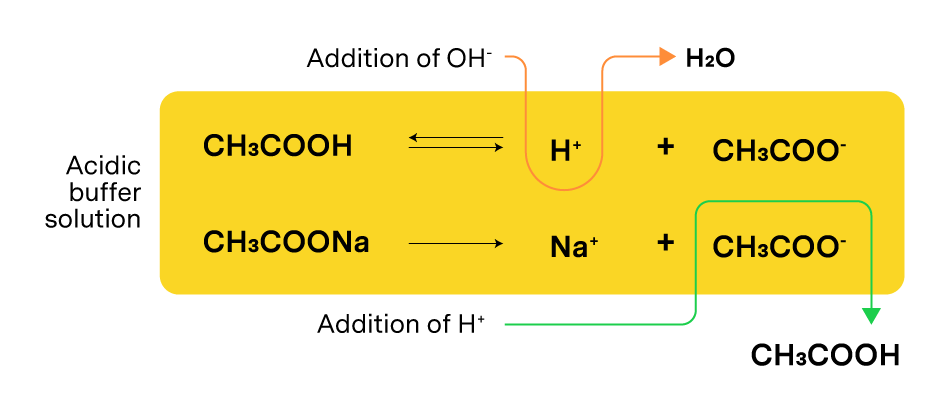
How do buffer solutions work in practice? Think of a buffer as having two components sitting in reserve. One is acidic and one is basic. Both are ready to mop up whatever gets added.
In an acidic buffer, added H⁺ reacts with the conjugate base: A⁻ + H⁺ → HA.
Added OH⁻ reacts with the weak acid instead: HA + OH⁻ → A⁻ + H₂O. So, the free H⁺ or OH⁻ never builds up enough to shift the pH much.
In an alkaline buffer, added H⁺ reacts with the weak base: B + H⁺ → BH⁺.
Meanwhile, added OH⁻ reacts with the conjugate acid: BH⁺ + OH⁻ → B + H₂O. Same idea, opposite direction.
Why Strong Acids and Bases Don’t Make Buffers
Let’s clarify a common mix-up: HCl + NaCl is not a buffer. Neither is NaOH + NaCl.
Strong acids and bases dissociate almost completely, so there’s no weak-species “reservoir” left to absorb extra H⁺ or OH⁻. The conjugate partners of strong acids and bases are very weak, such that they are unable to effectively neutralise any acids or bases added to them.
You need a weak acid or base plus its conjugate partner together in solution. Partially neutralising a weak acid with strong base can still form one, since leftover weak acid sits alongside its newly formed conjugate base.
The Henderson-Hasselbalch Equation (Buffer Solution Formula)
The buffer solution formula, commonly referred to as the Henderson-Hasselbaclh equation, links your pH buffer solution value directly to the ratio of your two components.
First, note the following:
- pH / pOH: acidity or alkalinity of buffer
- pKa / pKb = strength of weak acid or base
- [salt] = concentration of conjugate salt
- [acid] / [base] = concentration of weak acid or base
After that, convert using pH = 14 - pOH.
This is the buffer solution equation you’ll use for a lot of buffer questions in papers, actually.
For an easy rule, use the acidic version when Ka or pKa is given and use the alkaline version when Kb or pKb is given. Just confirm the conjugate pair first.
How to Calculate pH of a Solution
Wondering how to calculate pH of buffer solution questions? Follow this sequence every time so you don’t get lost:
Step 1: Identify the species in the question.
Step 2: Check if any react together (like a neutralisation).
Step 3: Work out what’s left over after that reaction, e.g., the moles of weak acid/base and its conjugate.
Step 4: Categorise the type of solution according to the species present. There can only be 8 types of solutions: a strong acid, a weak acid, an acidic buffer, an acidic salt, a strong base, a weak base, a basic buffer, and a basic salt.
Step 5: Identify the relevant pH formula (provided earlier for each buffer type).
Step 6: Substitute values into the formula for calculation. You can get these either from the question itself or through mole calculations.
Worked Example: Acidic Buffer
Say you have this scenario provided to you:
- CH₃COOH / CH₃COONa buffer
- 0.20 mol dm⁻³ [CH₃COOH]
- 0.15 mol dm⁻³ [CH₃COONa]
- Ka = 1.8 × 10⁻⁵
- Calculate pH
The solution flow would be as follows:
Here are some exam tips to follow for this:
- If [acid] = [conjugate base], then pH = pKa.
- If more conjugate base than acid, pH > pKa.
- If more acid than conjugate base, pH < pKa.
Worked Example: Buffer from Partial Neutralisation
This is where most students trip up, so it deserves its own walkthrough.
Say you have 25.0 cm³ of 0.200 mol dm⁻³ CH₃COOH.
It’s mixed with 10.0 cm³ of 0.100 mol dm⁻³ NaOH, and Ka = 1.8 × 10⁻⁵ (pKa = 4.74).
First, write the neutralisation equation: CH₃COOH + NaOH → CH₃COONa + H₂O.
The initial moles are 0.00500 mol CH₃COOH and 0.00100 mol NaOH. This means NaOH is the limiting reactant and reacts completely.
That leaves 0.00400 mol CH₃COOH (remaining) and 0.00100 mol CH₃COO⁻ (newly formed). This mixture is now an acidic buffer.
Because both species sit in the same 35 cm³ final solution, the species will be each divided by the same volume of 35/1000 dm³.
That leads to 4.74 + log (0.00100/0.00400) = 4.14.
The trap to avoid: never use the original 0.200 mol dm⁻³ CH₃COOH concentration directly in the formula. You have to account for the neutralisation first or the answer will be wrong even when the method looks right.
How to Create a Buffer Solution
If you’re figuring out how to create buffer solution mixtures, there are three ways:
- Mix a weak acid with a salt of its conjugate base.
- Mix a weak base with a salt of its conjugate acid.
- Partially neutralise either with a limited amount of the opposite strong species.
Note that you should pick a weak acid whose pKa is close to your target pH. The salt-to-acid ratio then fine-tunes it from there.
Buffers in Real Life: Blood Buffer System
This is a Singapore H2 syllabus requirement, so it’s worth knowing well.
Metabolism constantly produces acidic substances in the body, yet blood pH must stay within a narrow range. This is typically around 7.35-7.45.
The H₂CO₃/HCO₃⁻ system handles this. HCO₃⁻ removes excess added H⁺ while H₂CO₃ removes added OH⁻.
It’s exactly the same conjugate-pair principle covered earlier… just applied inside your bloodstream.
Common Mistakes to Avoid
- Thinking any acid + salt is an automatic buffer
- Forgetting a buffer needs weak acid or base and its conjugate partner
- Using a strong acid or strong base as buffer component
- Applying the formula before checking which species are present
- Using concentrations instead of moles after a neutralisation reaction
- Swapping the acid/base ratio in the formula
- Forgetting pOH to pH conversion for alkaline buffers
- Writing “pH remains constant” instead of “pH remains almost unchanged”
- Skipping the equations that show how H⁺ or OH⁻ are removed
- Add: Using reversible arrows in equation writing to demonstrate buffer action in removing H⁺ or OH⁻ added, instead of using single arrows (remember all equations representing buffer actions are neutralisation reactions which are irreversible)
Quick Recap
A buffer resists (but doesn’t stop) pH change because its conjugate pair removes added H⁺ or OH⁻. Always identify the species present, check for any reaction, then pick the matching formula before calculating.
Still finding buffer questions confusing even after this? AskMrChan's lessons break the topic down step-by-step, with exam-style questions, formula application practice, and common-mistake corrections built in.
Revision blocks
