
Lattice Enthalpy and the Born-Haber Cycle: Definition, Formula, Worked Example



Born-Haber cycles trip up a lot of Chemistry students. So many energy terms fly around that it can be harder than usual to figure out how they connect.
If you’ve struggled with that or understanding what is lattice enthalpy, this guide is for you. It sits under Chemical Energetics in the A-level Chemistry and IB Chemistry syllabus, and feeds into later questions on ionic compound trends like melting point and bond strength.
What Is Lattice Enthalpy?
IB Chemistry syllabus lattice enthalpy definition: energy absorbed when one mole of solid ionic compound dissociates into its constituent gaseous ions, under standard conditions of 25°C and 1 bar. For sodium chloride, that’s NaCl(s) -> Na⁺(g) + Cl⁻(g).
A-level Chemistry syllabus lattice enthalpy definition: energy released when one mole of solid ionic compound is formed from its constituent gaseous ions, under standard conditions of 25°C and 1 bar. For sodium chloride, that’s Na⁺(g) + Cl⁻(g) -> NaCl(s).
Ionic solids are held together in a lattice by strong electrostatic attraction between oppositely charged ions. Lattice enthalpy tells you how strong that attraction is: the bigger the number, the stronger the lattice.
What Affects the Size of the Lattice Enthalpy?
Two factors matter: ionic charge and ionic radius, since higher charge and smaller radius both mean stronger attraction and larger lattice enthalpy magnitude.
MgO beats NaCl this way (bigger charges, smaller ions). Meanwhile, NaCl beats KCl, as Na⁺ is smaller than K⁺ despite matching charges.
Why Can’t We Measure Lattice Enthalpy
You can’t combine gaseous ions in a lab and measure the energy change directly, so chemists use an indirect route based on Hess’ Law. The overall enthalpy change is the same regardless of route, as long as start and end points match.
This gives two routes from elements to ionic solid.
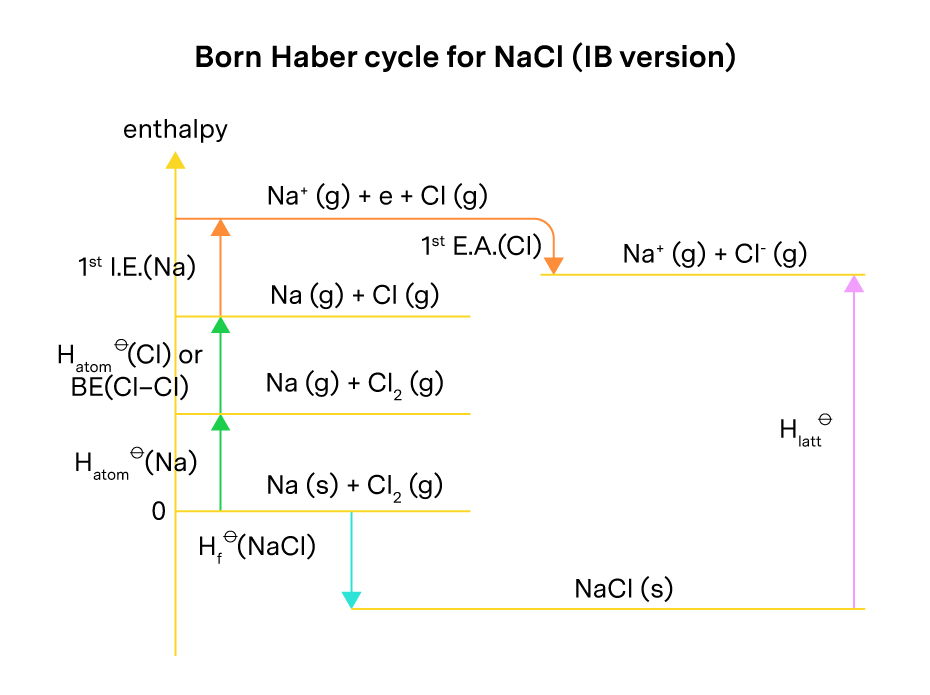
For the IB Chemistry syllabus, route 1 reacts elements to form solid ionic compound, then dissociates them into the gaseous ions:
Na(s) + ½Cl₂(g) → NaCl(s)
NaCl(s) → Na⁺(g) + Cl⁻(g)
Route 2 reacts elements to form the gaseous ions:
Na(s) + ½Cl₂(g) → Na⁺(g) + Cl⁻(g)
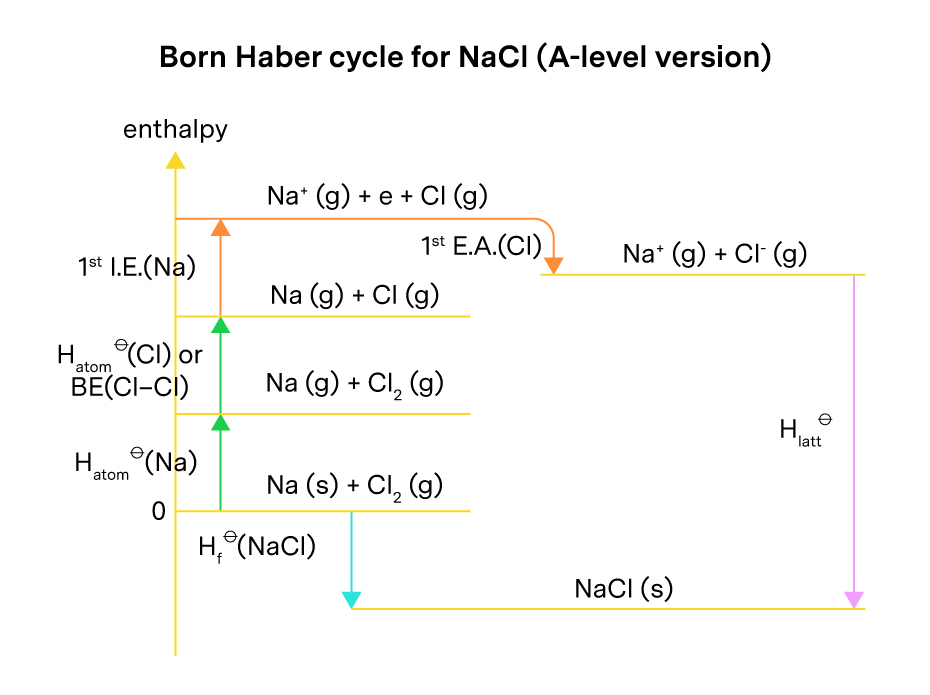
For the A-level Chemistry syllabus, route 1 reacts elements to form the gaseous ions, then onwards to the solid ionic compound:
Na(s) + ½Cl₂(g) → Na⁺(g) + Cl⁻(g)
Na⁺(g) + Cl⁻(g) → NaCl(s)
Route 2 reacts elements to form the solid ionic compound:
Na(s) + ½Cl₂(g) → NaCl(s)
The cycle linking both is the Born-Haber cycle.
The Lattice Enthalpy Formula (Hess’ Law Approach)
There isn’t one universal lattice enthalpy formula to plug numbers into. Instead, set both routes equal and solve for the unknown:
For the IB Chemistry syllabus:
ΔH°f + ΔH°lattice = ΔH°atomisation + ionisation energy + electron affinity
For the A-level Chemistry syllabus:
ΔH°f = ΔH°atomisation + ionisation energy + electron affinity + ΔH°lattice
Since ΔH°f is usually known, rearranging this equation actually gives you lattice enthalpy.
In the IB Chemistry syllabus, lattice enthalpy is defined as the energy absorbed when one mole of solid ionic compound dissociates into its constituent gaseous ions under standard conditions. This is an endothermic process, so lattice enthalpy is assigned a positive value.
In a Born-Haber cycle, the lattice enthalpy step is drawn as the upward arrow from the solid ionic compound to gaseous ions:
NaCl(s) → Na⁺(g) + Cl⁻(g)
ΔH°lattice = +786 kJ mol⁻¹
In the A-level Chemistry syllabus, lattice enthalpy is defined as the energy released when one mole of gaseous ions combines to form one mole of solid ionic compound under standard conditions. This is an exothermic process, so lattice enthalpy is assigned a negative value.
In a Born-Haber cycle, the lattice enthalpy step is drawn as the downward arrow from gaseous ions to the solid ionic compound:
Na⁺(g) + Cl⁻(g) → NaCl(s)
ΔH°lattice = -786 kJ mol⁻¹
Both definitions describe the same energy change, so the magnitude is identical — only the direction and sign convention differ.
Experimental vs. Theoretical Lattice Enthalpy
Lattice enthalpy calculated from a Born-Haber cycle is an experimental value with some covalent character, while the value given directly in a question is usually theoretical and assumes 100% ionic character. The size of that gap depends on the cation’s charge density (its polarising power) and the anion’s electron cloud size (its polarisability).
Energy Terms and Sign Conventions in a Born-Haber Cycle
Each step in the cycle is its own named energy term, and each has a fixed sign:
Here’s how the sign convention plays out across every step you’ll meet in a cycle:
The safest rule: don’t memorise any of these signs in isolation. Write out the thermochemical equation, check its direction, then decide if energy is being absorbed or released.
How to Construct a Born-Haber Cycle
Here’s how to construct Born-Haber cycle diagrams using the FAIL method.
- Formation: elements to compound.
- Atomisation: elements to gaseous atoms.
- Ionisation: gaseous atoms to gaseous ions. Ionisation energy before electron affinity, so that electrons have somewhere to go.
- Lattice:
- In IB Chemistry: solid ionic compound to gaseous ions
- In A-level Chemistry: gaseous ions to solid ionic compound
Once you have all four steps, apply Hess' Law by equating direct and indirect routes.
Worked Example: NaCl Lattice Enthalpy
Here’s how to draw Born-Haber cycle diagrams and calculate from them, using real data-booklet values.
ΔH°f[NaCl(s)] = -411
ΔH°at[Na(s)] = +108
Cl-Cl bond energy = +244
IE₁(Na) = +494
EA₁(Cl) = -349 (all kJ mol⁻¹)
Draw the direct arrow (ΔH°f = -411) from Na(s) + ½Cl₂(g) to NaCl(s).
Then for the indirect route, atomise both elements (+108, and half of 244 = +122), ionise sodium (+494), then add the electron to chlorine (-349), ending at Na⁺(g) + Cl⁻(g).
Applying Hess' Law: -411 = 108 + 122 + 494 - 349 + ΔH°latt.
That then simplifies to -411 = 375 + ΔH°latt, giving ΔH°latt = -786 kJ mol⁻¹, the lattice formation enthalpy. This calculation uses the H2 Chemistry lattice formation convention.
A note for IB Chemistry students:
In the IB Chemistry syllabus, lattice enthalpy is defined through dissociation instead. This means the value is written with the opposite sign:
ΔH°lattice = +786 kJ mol⁻¹
This represents the energy absorbed when one mole of NaCl(s) separates into its gaseous ions:
NaCl(s) → Na⁺(g) + Cl⁻(g)
Exam tip: the data booklet usually supplies ionisation energies, bond energies, and ionic radii. Other values are often given in the question itself.
Born-Haber Cycles for 2+/3+ Ions
Ions with charges greater than 1 need successive ionisation energies or electron affinities, adding extra steps to the cycle.
Aluminium in Al₂O₃ needs its first, second, and third ionisation energies summed for AI -> Al³⁺, while oxide ions need a first electron affinity (forming O⁻) plus a second, usually endothermic electron affinity (forming O²⁻).
Common Born-Haber Cycle Mistakes
- Using the dissociation definition but keeping the formation sign (or vice versa)
- Forgetting the ½ coefficient for Cl₂ when forming one mole of Cl atoms
- Using the full Cl-Cl bond energy instead of half of it
- Missing state symbols on any species in the cycle
- Forming aqueous ions instead of gaseous ions
- Omitting the second ionisation energy for a 2+ cation
- Forgetting to multiply electron affinity by the number of anions
- Reversing the electron affinity equation
- Changing the sign twice when rearranging
- Saying “higher lattice energy” without clarifying magnitude or sign
- Drawing disconnected pathways that don’t share the same start and end points
Quick Recap
Lattice enthalpy measures how strongly an ionic lattice holds together, and since it can’t be measured directly, we use the Born-Haber cycle and Hess' Law instead.
Build the cycle with FAIL (Formation, Atomisation, Ionisation, Lattice) and then equate both routes to solve for the missing value.
If you still find this confusing, reach out to AskMrChan’s tutors. Our lessons walk you through cycle construction and calculations step-by-step, in ways that make it easier to understand than ever.
Revision blocks
What is lattice enthalpy?
For IB Chemistry students:
The energy absorbed when one mole of a solid ionic compound dissociates into its constituent gaseous ions under standard conditions. It is an endothermic process with a positive value.
For A-level Chemistry students:
The energy released when one mole of a solid ionic compound is formed from its constituent gaseous ions under standard conditions. It is an exothermic process with a negative value.
Is lattice enthalpy positive or negative?
It depends on the syllabus convention being used. In IB Chemistry, lattice enthalpy is defined through dissociation, so it has a positive value. In A-level Chemistry, lattice enthalpy is defined through formation, so it has a negative value. Both describe the same energy change, but in opposite directions.
What is the lattice enthalpy formula?
There’s no single formula. You use Hess' Law to equate the direct and indirect routes in a Born-Haber cycle and solve for the unknown term.
Why isn’t lattice enthalpy measured directly?
Combining or separating gaseous ions experimentally is impractical, so an indirect Born-Haber cycle based on Hess' Law is used instead.
What makes lattice enthalpy larger in magnitude?
Higher ionic charge and smaller ionic radius both increase the strength of attraction within the lattice.
Is lattice energy the same as lattice enthalpy?
The terms are often used interchangeably in school resources, but you should state which convention (formation or dissociation) you’re using.
