
How to Draw Dot-and-Cross Diagrams: Step-by-Step (O-Level Chemistry)



Chemical bonding makes sense in theory… until you’re asked to draw it. If you’ve ever felt unsure about how to draw a dot-and-cross diagram, you’re not alone. It’s a common sticking point for O-Level and IP Chemistry students.
Here’s what usually goes wrong:
- You just don’t know how to turn bonding into a diagram.
- You forget if electrons are transferred or shared.
- You’re unsure when brackets or charges are required.
- Counting lone pairs trips you up.
- The electron count in your diagrams never adds up.
Dot-and-cross diagrams are examined under O-Level ionic and covalent bonding, and questions won’t always ask you to draw a substance you’ve memorised. Sometimes you need to deduce molecules from scratch.
But once you know how to do dot-and-cross diagrams confidently, such questions become easier. Here’s a complete guide on understanding dot-and-cross diagrams and how to draw them.
What Is a Dot-and-Cross Diagram?
A dot-and-cross diagram is a visual representation of the valence electrons involved in bonding between atoms. It shows exactly where the electrons involved in bonding originally came from.
- Dots = electrons from one atom
- Crosses = electrons from another atom
A few things to keep in mind:
- Dots and crosses are both electrons, and the symbols only distinguish their origins.
- The diagram usually focuses on valence electrons only.
- A shared pair of electrons = one covalent bond.
- A transferred electron = ion formation.
Valence Electrons (The Key to Every Diagram!)
Before you can draw anything, you need to know how many valence electrons each atom has. For the main-group elements commonly covered at O-Level, you can use the group number to work out how many valence electrons an atom has.
Here’s a quick reference table:
Most atoms aim for 8 outer-shell electrons. This is called the octet rule, and it includes both bonding pairs and lone pairs. Hydrogen follows the duplet rule instead, as its first shell can hold only 2 electrons.
Exam tip: once you know the atom’s group number, you know these:
- How many valence electrons it has
- How many electrons it’s likely to lose, gain or share
- Its expected ion charge or typical number of bonds
Is It Ionic or Covalent?
Before you pick up your pencil, find out which type of bonding you’re dealing with. The diagram changes based on the answer.
Ionic bonding usually happens between a metal and a non-metal.
Mechanism:
- Electrons are transferred from metal to non-metal.
- The metal loses electrons and forms a cation.
- The non-metal gains electrons and forms an anion.
- The oppositely charged ions attract each other.
Diagram clues:
- Separate ions, drawn apart from each other
- Square brackets around each ion
- Charges outside brackets
- No overlapping shells or shared pairs
Covalent bonding usually happens between two non-metals.
Mechanism:
- Electrons shared, not transferred.
- Each shared pair forms one covalent bond.
- Atoms achieve stable outer-shell configurations.
Diagram clues:
- Atoms connected through shared electron pairs
- Lone pairs still shown
- No ionic charges for neutral molecules
- No square brackets for neutral molecules
One more thing: always identify the elements first. Don’t decide solely based on whether the substance is solid, liquid, or gas. That’s a common trap.
How to Draw Dot-and-Cross Diagrams for Giant Ionic Lattice Structures
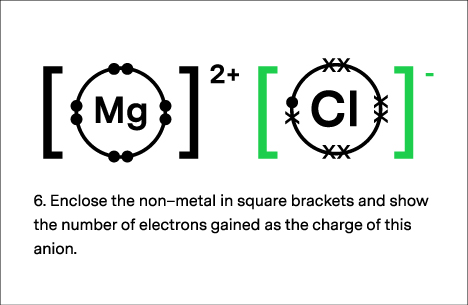
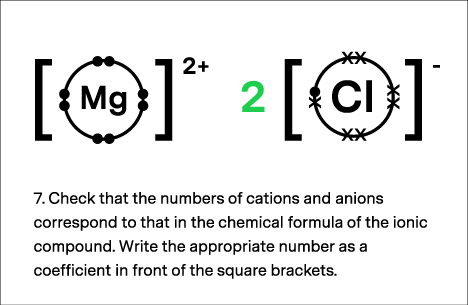
1. Write down the chemical formula of one formula unit of the ionic compound: for example, MgCl2.
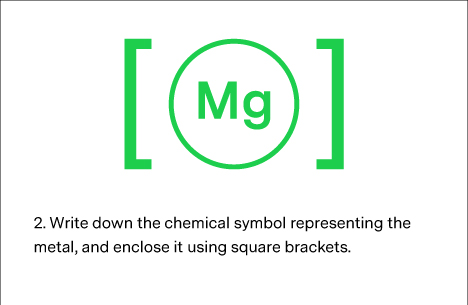
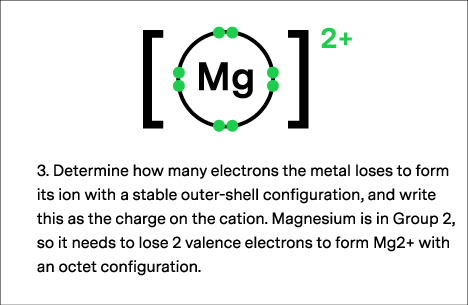
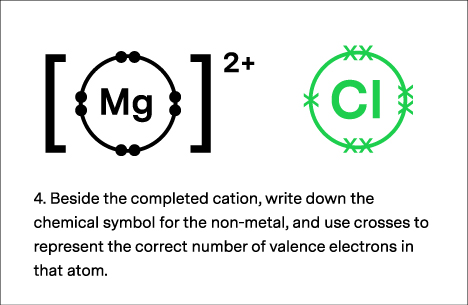
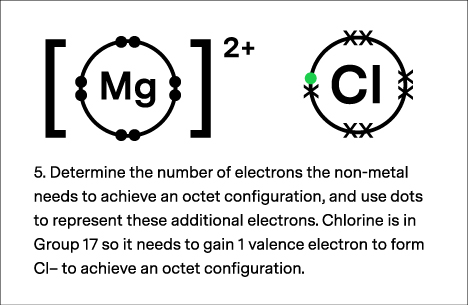
Worked Example: Sodium Chloride (NaCl)
- Sodium or Na has 1 valence electron while Chlorine or Cl has 7.
- Na loses 1 electron, so only one chloride ion is needed.
- Na transfers 1 electron to Cl, which forms Na⁺ and Cl⁻.
- Both ions are placed in their own square brackets.
- The chloride outer shell contains 7 original electrons + 1 transferred electron, for a full octet of 8.
How to Draw Dot-and-Cross for Simple Molecular Structures
Now let’s cover how to draw dot and cross diagrams for covalent bonding, using water and carbon dioxide as our worked examples.
1. Write down the chemical formula of the simple molecule: for example, H2O.
2. Determine the number of valence electrons present in each atom. Hydrogen has 1 valence electron and oxygen has 6.
3. Note the next nearest noble gas for each atom, and determine the number of electrons the atom requires to achieve that stable configuration. For H, the next nearest noble gas is He with 2 valence electrons. So, H needs 1 more electron to achieve the stable noble gas electronic configuration. For O, the next nearest noble gas is Ne with 8 valence electrons. So, O needs 2 more electrons to achieve the stable noble gas electronic configuration.
4. Use dots and crosses to show which atom each electron in a shared pair originally came from. Each shared pair represents one covalent bond. Hydrogen forms 1 covalent bond, while oxygen forms 2 covalent bonds.
5. Draw the electrons as alternating dots (•) and crosses (x).
6. Check that each atom has a total of eight valence electrons (except the hydrogen atom, which has two valence electrons), once the shared electrons are included.

Worked Example: Carbon Dioxide, CO₂
- Count electrons. Carbon contributes 4, and each oxygen contributes 6, yielding a total of 16 valence electrons.
- Arrange the atoms: O-C-O, with carbon as the central atom.
- Determine bonding needs: carbon needs 4 additional electrons and each oxygen needs 2. Carbon ends up sharing 2 electron pairs with each oxygen.
- Draw the double bonds as O=C=O. In dot-and-cross form, this means 2 shared pairs between carbon and each oxygen, so each double bond contains 4 electrons, shown as 2 sets of alternating dots and crosses.
- Add lone pairs: each oxygen keeps 2 lone pairs and carbon has none.
- Check the octets. Carbon has 8 electrons, each oxygen has 8 electrons, and the total across the molecule is 16.
Watch out for these common mistakes with CO₂:
- Drawing two single bonds only.
- Leaving carbon with an incomplete octet.
- Adding incorrect lone pairs to carbon to “fix” the electron count.
Quick Pattern Examples from the O-Level Syllabus
These patterns help show the relationship between an atom’s valence electrons and the number of bonds it forms. They can prepare students to deduce unfamiliar molecules’ diagrams.
- H₂
- Each H contributes 1 electron
- 1 shared pair
- Each H achieves a duplet
- O₂
- Each O has 6 valence electrons
- 2 shared pairs (a double covalent bond)
- 2 lone pairs per oxygen
- CH₄
- Carbon has 4 valence electrons
- Shares 1 electron with each of 4 hydrogen atoms
- 4 single bonds
- Carbon achieves an octet
- Each H achieves a duplet
- Cl₂
- One shared pair, plus three lone pairs per Cl
- One shared pair, plus three lone pairs per Cl
- N₂
- Three shared pairs (a triple covalent bond), plus one lone pair per N
- Three shared pairs (a triple covalent bond), plus one lone pair per N
Ionic vs Covalent Dot-and-Cross Diagrams at a Glance
Create comparison table with the following features to compare:
The core contrast to remember:
- Ionic: electrons are transferred, and charged ions shown separately
- Covalent: electrons are shared, and atoms are joined in one molecule
Common Dot-and-Cross Diagram Mistakes to Avoid
Ionic diagram errors:
- Sharing electrons instead of transferring them
- Forgetting square brackets
- Missing or incorrect ion charges
- Using the wrong number of ions for formula
- Showing an incomplete anion octet
- Placing the transferred electron outside the anion’s shell
- Drawing MgCl₂ with only one Cl⁻
- Drawing a full lattice when only ion formation is required
- Calling an ionic formula unit a “molecule”
Covalent diagram errors:
- Forgetting lone pairs
- Using the wrong number of shared pairs
- Putting both bonding electrons from the same atom
- Using single bonds where double bonds are required
- Giving hydrogen 8 electrons instead of 2
- Adding brackets/charges to neutral molecules
- Counting shared electrons for only one atom
- Drawing correct bonds but wrong total electron count
Share the common general errors:
- Mixing dots and crosses inconsistently
- Drawing inner-shell electrons unnecessarily
- Missing atom symbols
- Not checking the formula first
- Confusing electron symbols with positive/negative charges
Revision blocks
What do dots and crosses represent?
Dots and crosses represent valence electrons from different atoms. They’re the same type of particle. The different symbols are only there to show which atom each electron came from.
Do I draw every electron in a dot-and-cross diagram?
For the examples in this guide, you only need to do outer-shell (valence) electrons. That said, always follow the exact wording of the question. If it specifically asks for the full electronic structure, draw the inner shells too.
When do I use brackets and charges?
Use square brackets and charges around ions in ionic diagrams. Charged polyatomic species may also be shown in brackets with their overall charge. Don’t use brackets or charges around ordinary neutral molecules
How do I know how many bonds an atom forms?
For simple covalent molecules, compare the number of valence electrons with the stable octet or duplet configuration. The number of electrons an atom needs to complete that configuration can help you determine how many covalent bonds it typically forms.
Why does oxygen form two bonds?
Oxygen has 6 valence electrons, so it needs 2 more to complete its octet. It usually does this by sharing 2 electrons, forming 2 covalent bonds.
How do I draw double bonds in dot-and-cross diagrams?
Show 2 shared electron pairs between the same 2 atoms. That gives you 2 sets of alternating dots and crosses, as in each C=O bond in CO₂.
Still feel unsure about a specific step? A little guided practice goes a long way with chemical bonding, so feel free to reach out to us at AskMrChan.
Enquire today for personalised chemistry tuition and get a trial class!
