
Why Do Compounds Have Different Melting and Boiling Points? (A-Level / IB Chemistry)



Here’s something that confuses a lot of students. Sodium chloride melts above 800°C and chlorine gas boils below -30°C, yet both involve strong bonds.
It’s confusing because most students pick up on these rules of thumb early on:
- Ionic compounds usually have high melting points.
- Simple molecular substances usually have low melting and boiling points.
The trouble is that both substance types also contain strong bonds somewhere, so we can’t simply say “strong bond = high melting point”. That shortcut falls apart when an exam hands you an unfamiliar substance.
That’s exactly why this topic matters. In H2 Chemistry, structure and bonding are the tools you use to explain physical properties.
Structured questions love to test this. They might give you a familiar compound, or one you’ve never seen before.
Either way, memorising individual melting points won’t save you. What you need is a reasoning framework… and this is a complete guide to that framework, step by step.
Do Compounds Have Fixed Melting and Boiling Points?
Short answer: yes, but with conditions attached.
A pure substance has characteristic melting and boiling points under specified conditions, including pressure. Pure water, for example, melts at 0°C and boils at 100°C at standard atmospheric pressure.
Change those conditions and the values can change. Boiling point is particularly sensitive to pressure, which is why water boils below 100°C at higher altitudes.
Melting points are generally much less affected by pressure than boiling points, but impurities can lower and broaden the melting range rather than producing a sharp melting point.
So, a “fixed” value always assumes a pure substance under stated conditions.
This means different compounds have different values because their structures and the forces holding their particles together are different.
To explain differences, you need to identify two things: what particles are present and what holds them together.
The SIA Method: Explaining the Melting and Boiling Point of Compounds
At AskMrChan, we teach a simple three-step framework for this: the SIA method.
S = Structure
Structure tells you which particles must be separated when a substance melts or boils. You can identify the structure as one of four broad types:
- Giant ionic
- Giant covalent
- Giant metallic
- Simple molecular
I = Interactions
Next, identify the forces of attraction being overcome:
- Giant ionic, with strong electrostatic attraction between oppositely charged ions
- Giant covalent, with strong covalent bonds extending throughout the structure
- Giant metallic, with strong electrostatic attraction between positive metal ions and delocalised electrons
- Simple molecular, with intermolecular forces between molecules
Here’s a misconception to watch: when a simple molecular substance melts or boils, you do not break the covalent bonds inside the molecule. You overcome weaker intermolecular forces between molecules instead. The molecules themselves stay intact.
A = Amount of Energy
Stronger or more extensive attractions need more energy to overcome the forces, giving a higher melting and boiling point. Weaker attractions need less energy, giving a lower one.
That’s the whole logic. The rest of this guide simply applies SIA to each structure type.
Why Giant Ionic Compounds Usually Have High Melting Points
Start with structure. Ionic compounds form a giant ionic lattice.
Oppositely charged cations and anions are arranged in a regular, repeating pattern throughout that lattice.
Now the interaction. Every ion is held by strong electrostatic attraction to the oppositely charged ions surrounding it.
Overcoming all of those attractions takes a large amount of energy. That’s why ionic compounds often have high melting and boiling points.
But ionic compounds can vary quite a lot too. Two factors change how strong the attraction is, as summed up in the lattice energy formula, which determines ionic bond strength:
- The charge of the ions. Higher ionic charges mean stronger electrostatic attraction, so more energy is needed.
- Ionic radius. Smaller ions sit closer together, shortening the distance between opposite charges and strengthening the attraction.
Compare MgO and NaCl, for example. Magnesium oxide contains Mg²⁺ and O²⁻ ions, while sodium chloride contains Na⁺ and Cl⁻ ions.
The ions in MgO have higher charges, and the Mg²⁺ and O²⁻ ions are smaller than the corresponding Na⁺ and Cl⁻ ions. The stronger electrostatic attractions in MgO therefore require more energy to overcome.
MgO has a much higher melting point — around 2850°C, compared with about 800°C for NaCl.
Covalent Compounds Melting Point: Why Giant Molecular Substances Are So High
Here’s where covalent compounds surprise people. Some of them have among the highest melting points of all.
Take diamond and graphite, which are classic H2 Chemistry examples. Both are giant molecular (giant covalent) structures.
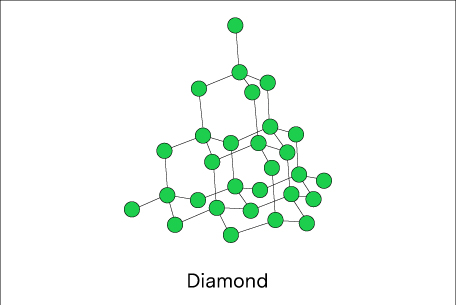
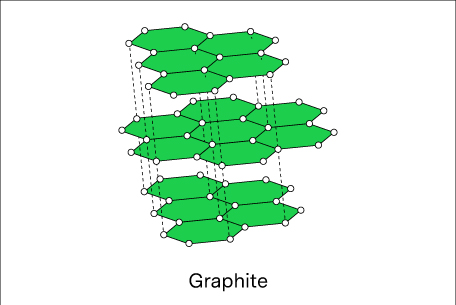
Both are made of giant covalent structures in which atoms are joined by strong and extensive covalent bonds throughout the structure. Changing these structures into a liquid requires breaking many strong covalent bonds, which requires a very large amount of energy.
As a result, giant molecular substances generally have extremely high melting points. Some, such as graphite, sublime rather than melt at atmospheric pressure.
This is why one distinction matters so much: giant molecular isn’t the same as simple molecular.
Both have covalent bonds. However, the structure is completely different, so their physical properties differ dramatically.
Why Metals Usually Have High Melting Points
Metals follow the same SIA logic. Structure first: a giant metallic lattice. Positive metal ions sit in a regular arrangement and are surrounded by a “sea” of delocalised electrons.
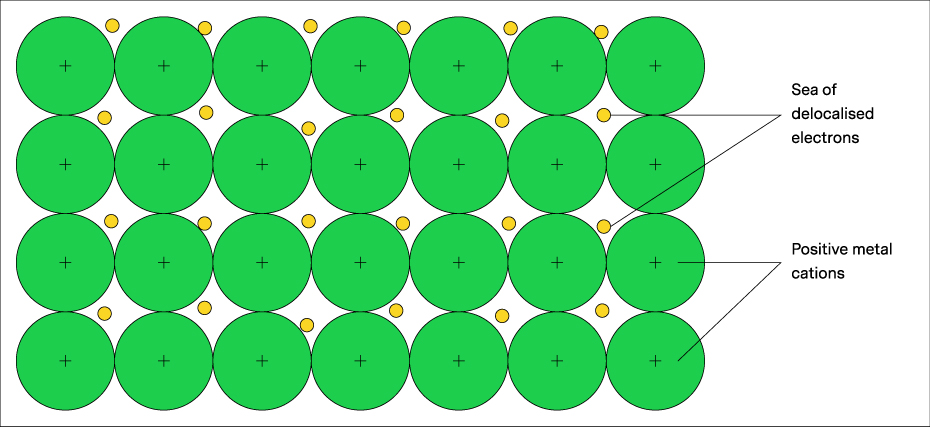
The interaction is the strong electrostatic attraction between those positive metal ions and the delocalised electrons around them.
Overcoming it needs a lot of energy, giving most metals high melting points. The strength of metallic bonding depends on factors including the charge density of the metal ions and the number of delocalised electrons contributing to the metallic bonding.
In general, stronger metallic bonding requires more energy to overcome, resulting in a higher melting point.
Why Simple Molecular Substances Usually Have Lower Melting and Boiling Points
Now the other end of the scale. Simple molecular substances do contain strong covalent bonds, but only inside each molecule.
Between molecules, the story changes. Neighbouring molecules are held together by much weaker intermolecular attractions.
When the substance melts or boils, these intermolecular forces are overcome. The covalent bonds inside each molecule itself stay intact.
Because intermolecular forces are relatively weak, far less energy is needed. That’s why simple molecular substances generally have lower melting and boiling points than giant structures.
The Three Intermolecular Forces You Need to Know
1. Instantaneous Dipole-Induced Dipole Attraction (id-id)
This occurs between non-polar molecules. Non-polar molecules generally have a symmetrical molecular geometry resulting in no net dipole moment.
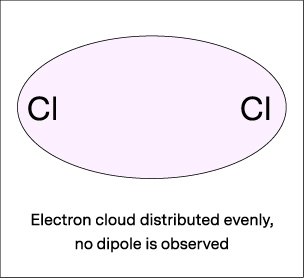
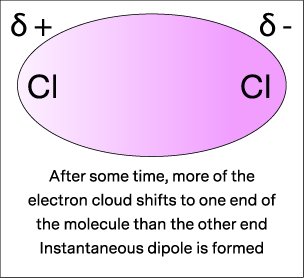
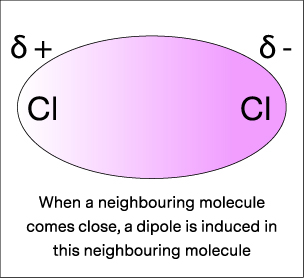
Its strength depends on two things:
- Electron cloud size: more electrons and a larger, more polarisable electron cloud create stronger instantaneous dipoles, and so stronger attraction. Compare Cl₂ → Br₂ → I₂. As the electron cloud grows, the attraction strengthens, more energy is needed, and boiling point rises.
- Surface area of contact: for similarly sized molecules, greater surface contact allows stronger cumulative intermolecular attraction, and potentially a higher boiling point. This usually applies to chain isomers of organic molecules.
2. Permanent Dipole-Permanent Dipole Attraction
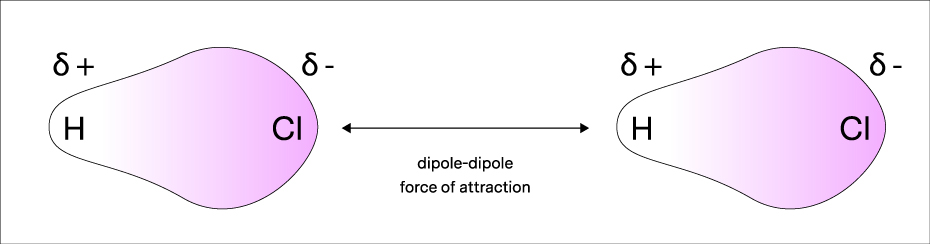
This occurs between polar molecules, such as HCl. A permanent δ+ region on one molecule is attracted to a permanent δ− region on another.
Its strength depends on the molecular polarity. The larger the size of the permanent dipole, the stronger the attraction.
3. Hydrogen Bonding
This occurs when suitable molecules contain an H–F, H–O, or H–N bond, such as water, H2O and ammonia, NH3.
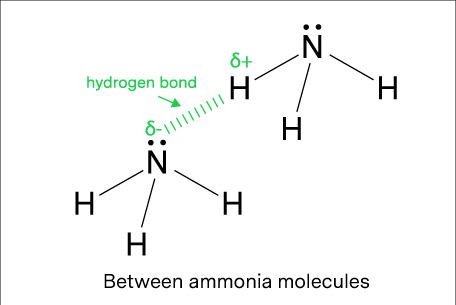
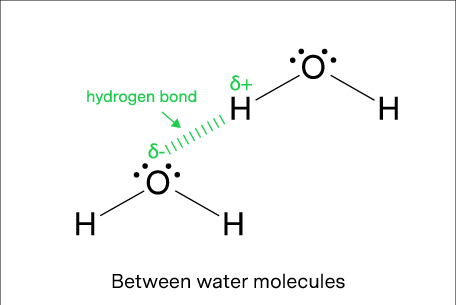
Hydrogen bonding often gives molecules unusually high boiling points compared with similar-sized molecules that cannot form it. Two factors affect its strength:
- Extensiveness: the more hydrogen bonds that can form between neighbouring molecules, the more interactions must be overcome, raising the melting and boiling point. Think of it as a spider spinning more web, making it stronger and more difficult to break.
- Polarity: where extensiveness is comparable, a more polar H-X bond yields stronger hydrogen bonding. Think of ammonia versus water, where both are similarly sized but the O-H bond in water is more polar than the N-H bond in ammonia, resulting in a higher boiling point of water (100 oC) than ammonia (-33 oC).
The Intermolecular Force “Strength Ladder”
For molecules of comparable size, the relative strength of these intermolecular attractions is generally:
- Instantaneous dipole-induced dipole < permanent dipole-permanent dipole < hydrogen bonding
But don’t treat this as an absolute law. Molecular size can override the ladder entirely. A very large non-polar molecule can have surprisingly strong id-id attractions.
So, a small polar molecule won’t automatically win. Always weigh the type, strength, and extensiveness of the forces together, not the ladder alone.

How to Determine Melting Point of Compounds
Time to pull everything together into a repeatable method. Here’s how to explain and compare the melting and boiling points of compounds.
- Identify the structure: giant ionic, giant molecular, giant metallic, or simple molecular.
- Identify the particles: ions, atoms, metal ions and delocalised electrons, or molecules.
- Identify the interaction being overcome: ionic attraction, covalent bonds, metallic bonds, or intermolecular forces.
- If simple molecular, identify the dominant intermolecular attraction: instantaneous dipole-induced dipole, permanent dipole-permanent dipole, or hydrogen bonding.
- Compare the strength and extent of the relevant attractions: consider factors such as ionic charge and ionic size, electron-cloud size and polarisation, molecular polarity, and the extent of hydrogen bonding.
- Link to energy: stronger or more numerous interactions mean more energy is required.
- State your conclusion: therefore substance X has a higher or lower melting or boiling point.
Worked Example 1: Ionic vs Simple Molecular
The example of NaCl vs H₂O shows the difference between naming a structure and explaining a property.
NaCl
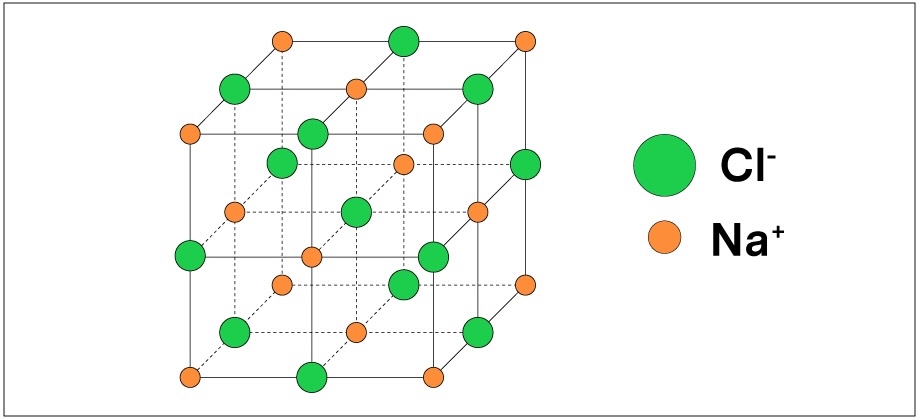
- Structure: giant ionic
- Interaction: strong electrostatic attraction between Na⁺ and Cl⁻
H₂O
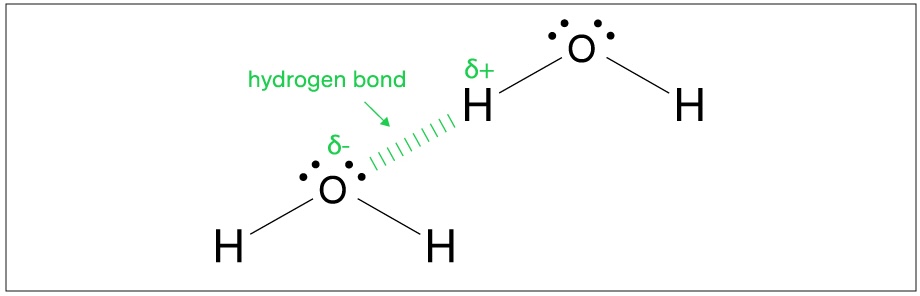
- Structure: simple molecular
- Interaction: hydrogen bonds between water molecules
Conclusion: the ionic attractions in MgO are much stronger than the hydrogen bonds in water. Substantially more energy is needed to overcome them. So, MgO has a much higher melting point.
Worked Example 2: Two Simple Molecular Substances
The example of H₂O vs CH₄ teaches you how to compare when structures are the same but the intermolecular forces differ. Both water and methane are simple molecular substances, so the deciding factor is the strength of their intermolecular attractions.
- H₂O: hydrogen bonding
- CH₄: instantaneous dipole-induced dipole attraction
Conclusion: the attractions between water molecules are stronger. More energy is required to overcome them, so water has a higher boiling point.
Worked Example 3: Intermolecular Force
Sometimes two substances share the same type of force, and you still have to compare strength.
Both bromine and iodine are simple molecular and non-polar, so both rely on instantaneous dipole-induced dipole attraction.
The difference is size. I₂ has a larger, more easily polarised electron cloud, resulting in stronger instantaneous dipole-induced dipole attractions.
More energy is therefore needed to separate iodine molecules. So, I₂ has a higher boiling point.
Worked Example 4: Surface area of contact between adjacent molecules
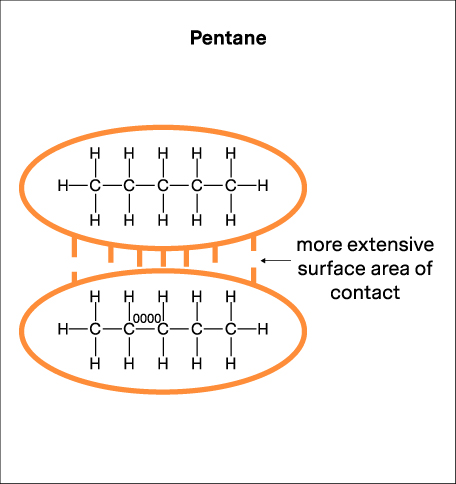
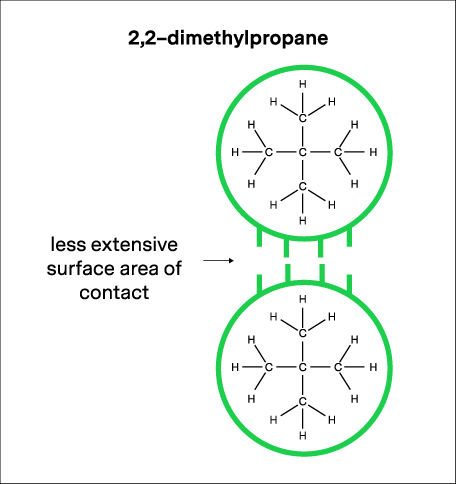
Pentane and 2,2-dimethylpropane are both simple molecular substances and experience instantaneous dipole-induced dipole forces of attraction between their molecules.
Pentane has a greater surface area of contact between adjacent molecules than 2,2-dimethylpropane. This allows its electron clouds to be distorted to a greater extent, resulting in stronger instantaneous dipole-induced dipole forces of attraction between the molecules.
As a result, more energy is required to overcome these intermolecular forces in pentane. Therefore, pentane has a higher boiling point than 2,2-dimethylpropane.
Common Explanation Mistakes to Avoid
You can easily lose marks on phrasing. Watch out for these so that doesn’t happen:
- Saying covalent bonds are broken when simple molecules boil
- Describing covalent bonds as “weak”
- Identifying structure but not naming interaction
- Naming interaction but not linking to energy
- Saying “stronger bonds = higher melting point” without specifying which bonds or forces
- Using “Van der Waals’ forces” without specifying the relevant intermolecular force when the question requires it
- Assuming hydrogen bonding always beats every other intermolecular attraction regardless of molecular size
- Comparing ionic compounds without considering charge or radius
- Confusing intermolecular forces with intramolecular bonds
- Saying substance has “more bonds” when meaning more intermolecular attractions
- Ending without explicitly stating which substance has a higher melting or boiling point
Revision Blocks
Do compounds have fixed melting and boiling points?
A pure substance has characteristic melting and boiling points under specified conditions, including pressure. The boiling point is particularly sensitive to pressure, while impurities can cause a substance to melt over a range rather than at one sharp temperature.
Why do covalent compounds usually have low melting points?
This applies only to simple molecular compounds. When they melt or boil, just the intermolecular forces between the molecules are overcome, and not the covalent bonds inside them.
Can covalent substances have high melting points?
Yes. Giant covalent substances such as diamond and graphite contain strong covalent bonds throughout their structures, so a very large amount of energy is required to disrupt the structure. Some giant covalent substances, such as graphite, sublime rather than melt at atmospheric pressure.
What determines the melting point of a compound?
Three things: its structure, the type and strength of the interaction holding its particles together, and the amount of energy needed to overcome that interaction.
Which intermolecular force gives the highest boiling point?
For molecules of comparable size, hydrogen bonding generally gives stronger intermolecular attraction than permanent dipole-permanent dipole or instantaneous dipole-induced dipole attractions. However, molecular size and the extent of the interactions also affect boiling point.
Why does a larger molecule often have a higher boiling point?
A larger electron cloud is more polarisable, creating stronger instantaneous dipole-induced dipole attraction.
Are intermolecular forces broken during boiling?
They are overcome between molecules, but the intramolecular covalent bonds remain intact.
Need help with this topic in Chemistry?
If you still need more guidance with converting structure and bonding into complete and well-phrased explanations that can help you get top marks on exams, reach out. We can help coach you through it at AskMrChan.
Enquire now for Chemistry tuition and get a trial class!
